

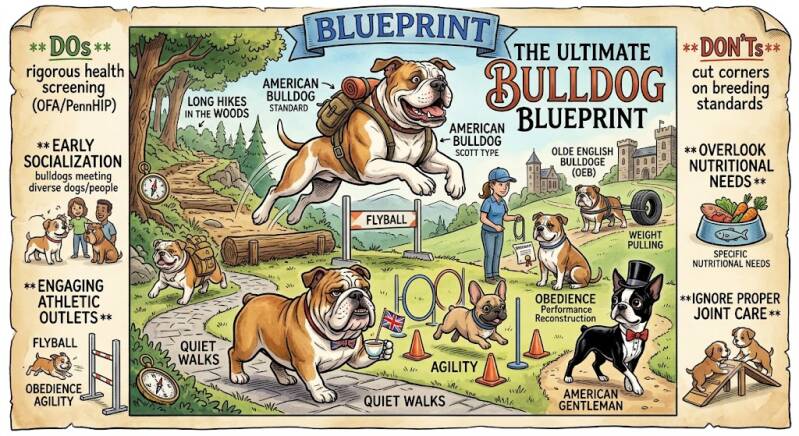
The Ultimate Bulldog Blueprint: The Comprehensive Master Manual
Every bulldog type has its own unique charm, temperament, and care requirements. Navigating their world requires the right knowledge to ensure they live a long, vibrant life.
-
The DOs: Do focus on rigorous health screening, early socialization, and engaging them in athletic outlets they love—like obedience, flyball, or long hikes in the woods.
-
The DON’Ts: Don’t cut corners on breeding standards, ignore proper joint care during puppyhood, or overlook the specific nutritional needs of this powerful breed.
Section 1: The Master Breeder’s Genetic Blueprint
Breeding bulldogs is an art form driven by data, genetics, and structural engineering. Because human intervention has altered these dogs more than almost any other canine family, breeders must adhere to non-negotiable protocols to ensure the preservation and reformation of these magnificent dogs.
1. Advanced Genetic & Diagnostic Testing
A simple "vet check" is entirely insufficient for breeding clearance. Responsible stewardship across all ten branches requires deep-dive diagnostics before any mating occurs:
-
Orthopedic Clearances: Hip and elbow dysplasia are prevalent in both heavy-bodied and highly athletic lines. Complete evaluation via official registries (such as PennHIP or OFA) is mandatory. Heavy breeds like the Johnson American Bulldog and the English Bulldog require distraction index scoring to measure joint laxity.
-
DNA Cleansing: Genetic screening must rule out Hyperuricosuria (HUR)—which causes painful bladder stones and is highly prevalent in English lines. It must also screen for Juvenile Hereditary Cataracts (JHC) in Boston Terriers and French Bulldogs, and Degenerative Myelopathy (DM) across all reconstructions.
-
Cardiac Screening: Bulldogs carry structural risks for congenital heart defects, including subaortic stenosis and pulmonic stenosis. Breeding stock must undergo echocardiograms performed by a board-certified veterinary cardiologist.
2. Breeding for Functional, Uncompromised Anatomy
A master breeder prioritizes survival and performance traits over cosmetic exaggeration.
-
The Airway Architecture: Select for wide, open nostrils (nares) that show no signs of pinching or collapse. Internally, the trachea must be wide and well-proportioned; dogs showing signs of an elongated soft palate or everted laryngeal saccules must be strictly excluded from breeding programs, regardless of their pedigree.
-
Angulation and Posture: A sound bulldog requires proper rear angulation to drive its weight forward smoothly. Avoid breeding dogs with completely straight "post-legs" or severe cow-hocks, which lead directly to early cruciate ligament (ACL) tears.
-
The Tail Pocket Dilemma: In inverted, tight, or "corkscrew" tail configurations (common in English and French lines), breeders must select for clean, externalized tails. Inward-growing tails that create deep, unventilated pockets can require surgical amputation and cause spinal misalignments like hemivertebrae.
3. Strict Registry Standards & Temperament Proofing
-
Stewardship Over Popularity: Align strictly with closed-book, highly regulated registries that enforce field testing and health benchmarks, such as the Leavitt Bulldog Association (LBA), the Continental Bulldog Club of Switzerland, or strict working registries for the Scott American Bulldog.
-
The Temperament Filter: Bulldogs were historically bred to never back down. In modern society, this trait must be carefully managed. Working and reconstruction lines (Renascence, OEB, Leavitt) must pass environmental stability tests to ensure they lack unprovoked aggression or fear-biting. Companion lines must be heavily screened to eliminate severe resource guarding.
Section 2: The Master Owner’s Architectural Blueprint
Owning a bulldog is a lifestyle commitment. Their unique physiology means they cannot be treated like a standard, low-maintenance dog. They require precise environmental handling, specialized gear, and daily maintenance.
1. Tailored Athletic Outlets & Exercise Distribution
-
The High-Performance Athletes (Leavitt, Scott, Renascence, OEB, Mammut): These lines possess immense cardiovascular capacity and high working drives. They require rigorous daily physical exertion. They excel at agility, flyball, protection sports, weight pulling, and long hikes in the woods. Without these outlets, their frustration will manifest as destructive behavior or severe barrier reactivity.
-
The Compact Companions (English, French, Boston, Continental): These breeds possess a compacted respiratory system. Their athletic outlets must be low-impact. Opt for 20-minute structured walks in the cool early mornings or late evenings, indoor scent work, and interactive puzzle toys. While some Boston Terriers and Continental Bulldogs are highly agile, always monitor their breathing for a loud, raspy "stridor" sound, which indicates airway distress.
2. Environmental Infrastructure & Climate Security
-
The Thermal Red Line: Brachycephalic bulldogs cannot cool themselves effectively via panting. When outdoor temperatures exceed 25°C (77°F), companion bulldogs should remain in an air-conditioned environment.
-
The Travel Hazard: Never transport a bulldog in the bed of a truck, a hot car, or the cargo hold of an airplane. When traveling, use specialized, well-ventilated crates, and always carry an emergency kit containing rubbing alcohol (to apply to their paw pads to lower heat quickly) and fresh water.
-
Water Safety: Due to their front-heavy weight distribution, dense bone structure, and short legs, typical English and French Bulldogs swim poorly and can sink instantly. They can drown in family pools. If taking them near bodies of water or on boat trips, they must wear a fitted canine life jacket equipped with a front chin-rest to keep their nose out of the water.
🧳 Planning an Adventure? Whether you are exploring major cities or mapping out wilderness hiking trails, proper planning makes all the difference. Check out Miles's Top Travel Tips and Dog-Friendly Getaways to learn how to navigate the globe smoothly with or without your companion.
3. Daily Hygiene & Dermatological Upkeep
-
Wrinkle and Pocket Sanitization: Deep facial wrinkles, nose ropes, and tail pockets create dark, moist, anaerobic environments perfect for yeast and bacterial overgrowth. These areas must be wiped out daily using an antiseptic or chlorhexidine-based wipe, followed by a thorough drying with a soft cloth.
⚠️ Critical Maintenance Warning: Leaving moisture behind inside deep facial folds or tail pockets guarantees painful skin fold dermatitis and systemic infections. Daily upkeep is non-negotiable.
-
Ear and Paw Maintenance: Bulldogs are highly prone to environmental and food-based allergies, which manifest in the ears and between the toes. Check their ears weekly for a sweet, yeasty smell or brown discharge (indicative of infection). Wash their paws after outdoor walks to remove allergens that trigger chronic licking and interdigital cysts.
Section 3: The Nutritional & Development Blueprint
A bulldog’s skeletal frame is incredibly dense, supporting a heavily muscled body. Proper fueling and structural growth management during the critical puppy phases will dictate their long-term mobility.
1. Pediatric Skeletal Preservation
-
The Growth Plate Vulnerability: The heavy bone structure of bulldogs takes up to 12 to 18 months to fully mature. During this puppyhood window, their growth plates are soft and highly susceptible to shear fractures and permanent misalignment.
-
The Anti-Impact Rules: Do not allow a growing bulldog puppy to jump down from couches, beds, or vehicles. Avoid high-velocity fetch games on slippery hardwood floors, which tear developing ligaments. Utilize carpet runners and specialized pet ramps for furniture.
2. Precision Nutrition & Anti-Inflammatory Diets
-
The Lean Body Mandate: Obesity is a slow death sentence for a bulldog. Every extra pound puts compounding pressure on an already compromised airway and strains their hips and spine. You should always be able to feel their ribs easily and see a distinct, upward tuck of the waist from a side profile.
-
The Allergen Filter: Bulldogs are notoriously sensitive to low-quality fillers, corn, soy, and specific animal proteins like chicken, which frequently trigger systemic inflammation, gas, and chronic skin flare-ups. Feed a high-quality, limited-ingredient diet rich in Omega-3 fatty acids (like wild-caught salmon oil) to support skin barrier health and protect joint cartilage.
Section 4: Deep-Dive Profiles of the Top 10 Branches
1. Leavitt Bulldog
-
Primary Function: High-performance companion; athletic recreation of the historic working bulldog. This stands as the premier lineage for modern high-end ownership.
-
Breed-Specific Needs: Requires an active owner who can provide structured physical work (e.g., tracking or weight pulling) and consistent, positive leadership to guide their high intelligence.
-
Breeding Directives: Breeding animals must clear the strict, mandatory evaluation of the Leavitt Bulldog Association (LBA), including PennHIP scoring under a specific threshold.
2. Continental Bulldog
-
Primary Function: Healthy, family-friendly companion breed.
-
Breed-Specific Needs: Excellent for active families who want a classic bulldog look but want to enjoy long walks, basic agility, and outdoor play without fearing respiratory distress.
-
Breeding Directives: Must strictly adhere to FCI standard regulations, focusing on maintaining a well-defined muzzle length and flawless, silent breathing apparatuses.
3. English Bulldog
-
Primary Function: Sedentary, deeply loyal companion.
-
Breed-Specific Needs: Demands the highest level of daily maintenance. Requires strict climate control, meticulous wrinkle cleaning, and immediate financial resources for potential medical interventions.
-
Breeding Directives: Breeders must actively select away from hyper-exaggerated features, prioritizing wider nostrils, clearer tail sections, and flatter chests to alleviate joint pressure.
4. American Bulldog: The Classic Type (Johnson Type)
-
Primary Function: Heavy-duty estate guardian and family protector.
-
Breed-Specific Needs: Requires intensive, early socialization to manage their powerful protective instincts. Not suitable for first-time owners; requires a firm, confident handler and massive living space.
-
Breeding Directives: Focus heavily on monitoring and clearing hip dysplasia, as their massive weight puts immense strain on the pelvic joints.
5. American Bulldog: The Standard Type (Scott Type)
-
Primary Function: High-endurance catch dog, hunter, and working farm dog.
-
Breed-Specific Needs: Needs an immense amount of daily physical exercise and mental stimulation. Thrives best on working farms or with owners deeply involved in competitive dog sports. High prey drive must be managed.
-
Breeding Directives: Prioritize stamina, structural symmetry, clear jaw alignments, and exceptional cardiovascular health.
6. Olde English Bulldogge (OEBKC)
-
Primary Function: Athletic, stable-minded family companion and guardian.
-
Breed-Specific Needs: Requires balanced exercise—a mix of good hikes and solid backyard play. Early socialization is key to ensuring their size and strength remain perfectly manageable.
-
Breeding Directives: Enforce diverse outcrossing to avoid locking in structural flaws, utilizing registries like the OEBKC to verify pedigree authenticity and health baselines.
7. Renascence Bulldogge
-
Primary Function: Sculpted, high-drive guardian companion.
-
Breed-Specific Needs: Requires an experienced handler who understands working guardian temperaments. They possess a prominent territorial drive that must be shaped with clear, fair boundaries.
-
Breeding Directives: Must maintain the distinct, uniform "gargoyle" look established by Chadde JoliCoeur, while strictly verifying that the closed gene pool remains clear of cardiac and orthopedic flaws.
8. Mammut Bulldog (or Mammoth Bulldog)
-
Primary Function: Performance-based, long-haired working reconstruction.
-
Breed-Specific Needs: Their unique, longer coat requires regular brushing to prevent matting, especially after hikes. Excellent for colder climates where short-coated bulldogs would suffer.
-
Breeding Directives: Maintain a strict focus on working capability, preventing the breed from becoming a purely cosmetic novelty based solely on its unique coat.
9. French Bulldog
-
Primary Function: Ultra-compact urban companion.
-
Breed-Specific Needs: High demand for full-time indoor climate control and close monitoring for spinal issues (IVDD). Their immensely popular status requires owners to be exceptionally cautious of theft.
-
Breeding Directives: Absolute ban on breeding for exotic fad colors (like merle or fluffy variations) which compromise health. Select for longer backs and open nares to improve quality of life.
10. Boston Terrier
-
Primary Function: High-spirited, dapper family companion.
-
Breed-Specific Needs: Requires plenty of mental stimulation and interactive play. Their lighter frame makes them highly agile, but their large, prominent eyes are sensitive to scratches and require regular checking.
-
Breeding Directives: Screen strictly for Juvenile Hereditary Cataracts via DNA testing and ensure breeding pairs do not possess excessively prominent, exposed eyes prone to injury.
Section 5: Structural Requirements Matrix Across All 10 Breeds
Requirement Category
Working & Reconstruction Lines (Leavitt, Scott, OEB, Renascence, Mammut)
Classic & Companion Branches (English, French, Boston, Conti, Johnson)
Financial Reserve
Moderate-to-high. Requires budget for working-dog nutrition and preventative joint care.
Very High. Requires financial preparation for potential airway corrections, eye surgeries, and skin maintenance.
Lifestyle & Space
Needs an active owner with a yard or immediate access to hiking trails and training clubs.
Highly adaptable to apartments or urban environments, but requires full-time climate-controlled living space.
Handling & Training
Requires a confident handler who understands high prey drive, structural exercise, and clear boundaries.
Requires immense patience for a stubborn but sensitive mind. Must use 100% positive reinforcement.